
“You don’t know yourself well until you’ve been through the pain that nobody else sees.” Epiphany
That truth came to me quietly — not in comfort, but in confrontation.
Because there are two kinds of pain: the kind we can name, and the kind that lives unnamed inside us.
The visible kind makes sense to others. It earns empathy, conversation, and time off.
But the invisible kind — the pain we carry in silence — changes us in ways the world rarely understands.
It’s the ache behind the practiced smile.
The fatigue you can’t explain.
The grief that never had a proper goodbye.
That’s the pain that introduces you to yourself.
Not through reflection, but through survival.
When I was fourteen, I met that kind of pain for the first time.
It didn’t knock — it moved in.
After losing my parents, my brother, and the sacred tree where my mother once prayed, I began to believe peace had an expiration date. The world around me went on, but my world stopped.
I didn’t know what depression was. No one called it that.
I just knew that I had become a shadow of the girl I used to be — and no one noticed.
But in those silent hours, I learned something the world couldn’t teach me:
how to stay.
It’s in those unseen moments — when no one is watching, no one applauds, and no one rescues — that we discover what we’re really made of.
Not who we are when we’re loved, but who we are when we’re left with only ourselves.
Meeting Yourself in the Dark
There’s a strange kind of intimacy that happens in solitude — a self-knowing born not from reflection, but from endurance.
When life collapses and no one notices, you start to see what’s left standing.
You see the part of you that keeps showing up even when no one asks you to.
Pain that no one else sees has a way of stripping you bare.
It removes the performance — the version of you that tries to appear “okay” for others.
What’s left is something real: your instincts, your truth, your voice unfiltered by fear.
At fourteen, I didn’t have a therapist or a language for mental illness.
All I had was a journal — filled with tallies, one for every night I couldn’t sleep.
Seven hundred and ninety-five nights.
Sometimes I wonder if I was tracking my pain or my proof of existence.
Maybe both.
I remember using drugs for the first time — not to rebel, but to rest.
For the first time in years, my body was quiet. But peace borrowed is peace that leaves you bankrupt.
I learned that the things that silence our pain don’t heal it.
They only teach us to suffer in softer ways.
That’s what I mean by self-intimacy through suffering.
You can’t fake it when it’s just you and your ache.
You learn what safety feels like.
What compassion feels like.
What strength actually costs.
And somewhere in that process — between the breaking and rebuilding — you begin to trust yourself again.
The Myth of “Normal” Pain
Society makes space for certain kinds of pain — the ones with neat names and acceptable scripts: heartbreak, exhaustion, grief with a funeral and a timeline.
We know how to talk about those.
But there’s another kind — the “abnormal” pain.
The trauma that’s too cultural, too messy, too heavy to fit inside sympathy’s small box.
That’s the pain I lived with.
When I was finally diagnosed, family members called it weakness.
My medication was thrown out. My prayers were questioned. My spirit was labeled broken.
And yet, that’s the very pain that taught me my humanity.
We hide this pain because we fear it will make others uncomfortable. But it’s often the invisible pain that shapes our deepest wisdom.
In every culture, there’s a silence around mental health. In some, that silence is survival. In others, it’s a shame. Either way, it keeps too many people dying quietly — because they’ve been taught that their suffering is “too much.”
My quote was born from that place — from realizing that even the experiences labeled “unholy,” “strange,” or “too much” can become the exact soil where healing grows.
We are taught to disguise the wounds that don’t look tidy.
But the truth is: there’s nothing “abnormal” about surviving the unthinkable.
There’s only courage in finding a way to keep living when no one can see the storm inside you.
The Compassion That Follows
The ones who have known invisible pain often move through the world differently.
They don’t need to know your story to recognize your ache.
They feel it — in your pauses, in your posture, in the way your laughter sometimes sounds like relief.
Pain becomes a lens through which you see the world more softly.
When you’ve met yourself in that kind of darkness, you stop judging how others cope.
You stop labeling pain as weakness.
You learn to hold space for people who still can’t find the words.
I see it now — that the gift of unseen suffering is that it turns empathy into a language, not a performance.
It softens us.
It humbles us.
It reminds us that everyone is carrying something invisible.
And maybe, that’s what knowing yourself really means — not mastering your story but learning to live gently with it.
Lessons from the Darkness
Pain is a teacher that doesn’t speak our language — it speaks through experience, through lineage, through what our ancestors carried but could never name.
I grew up in a world where silence was survival.
In my African home, emotions were measured, grief was private, and mental illness was treated as spiritual warfare. You didn’t cry in public. You didn’t question God. You smiled and said, “I’m fine.”
But when you’ve been through pain that nobody else sees, silence can become its own kind of violence.
These are the lessons that helped me unlearn it.
🌙 Lesson 1: Silence isn’t strength.
Your voice is medicine. Even trembling words can heal what silence protects.
In my culture, silence is often mistaken for dignity.
To endure quietly is to be praised. To cry openly is to be pitied.
When I was a teenager navigating suicidal thoughts, I stayed silent because that’s what I was taught: the strong don’t speak of weakness.
Even as I shook, even as I starved myself, even as my body begged to be seen — I swallowed my truth.
But silence almost killed me.
Strength isn’t how well you hide your pain — it’s how bravely you give it a voice.
Speaking up wasn’t rebellion; it was survival.
And now, every time I share my story, I honor every child still learning how to speak theirs.
🌿 Lesson 2: You don’t owe anyone your speed.
Healing is not linear. Some wounds grow alongside you. Some never fully close, and that’s okay.
In many African communities, healing is expected to be fast — if you’re praying, you should be better. If you’re blessed, you shouldn’t be sad.
When my depression lingered, people told me to “move on,” as if time alone could cure a wound that hadn’t been tended to.
But grief doesn’t follow a calendar. Trauma doesn’t obey timelines.
I used to hate myself for not healing fast enough — until I realized I was living in a culture that confuses movement with progress.
Healing is not about rushing back to who you were.
It’s about learning to stand inside who you’ve become.
💫 Lesson 3: Compassion begins with curiosity.
Instead of asking, “What’s wrong with you?” ask, “What happened to you?”
That small shift changes everything.
When I was first diagnosed, an uncle threw away my medication and said,
“Depression is for the West. We don’t do that here.”
He wasn’t cruel — he was uninformed.
He came from a generation that didn’t have the language for mental health, only the fear of being seen as “possessed” or “weak.”
Years later, I realized how different things might have been if someone had simply asked, “What happened to you?” instead of, “What’s wrong with you?”
That question changes everything.
It turns judgment into understanding.
It’s the bridge between stigma and compassion.
🕊 Lesson 4: Your pain is not proof of failure.
It’s evidence that you’ve loved, lost, and lived deeply enough to feel.
For a long time, I believed my suffering meant I had disappointed God — that faith and fear couldn’t coexist.
But pain is not punishment. It’s proof that you’ve lived deeply enough to feel the world.
When I lost my parents, my community said, “You must stay strong.”
When I broke down, they said, “You’re losing faith.”
But I’ve learned that sometimes faith looks like falling apart — and trusting that you’ll rise differently.
Sometimes strength looks like saying, “I’m not okay, but I still believe in tomorrow.”
Pain doesn’t mean you failed.
It means you’re human.
🌍 Lesson 5: Culture shapes silence.
If you were taught to hide your emotions — to be “grateful,” to “pray harder,” to “toughen up” — please know: healing asks you to unlearn survival, not shame it.
Pain, when faced with tenderness, becomes power.
In many African homes — and across cultures globally — mental health remains a forbidden language.
We inherit silence the way we inherit skin tone: without choice, but not without consequence.
My family prayed over me, fasted for me, tried to discipline the “darkness” out of me.
They didn’t understand that trauma lives in the nervous system, not the devil’s hand.
But I understand now — they were doing what they knew.
Their fear came from a history of survival, where showing emotion could be dangerous, where vulnerability could cost your dignity, your reputation, your life.
So I no longer blame them.
I am educated. I speak. I built the bridge they couldn’t cross.
Culture may shape silence, but courage rewrites it.
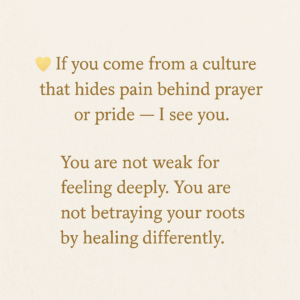
You are expanding the story — for yourself, for your ancestors, for the children who will come after you and never have to hide like you did.
🕯 That’s how we heal generational silence — by speaking the truth out loud, together.
The Invitation to See Each Other
When you’ve walked through invisible pain, you begin to recognize it in others — in the strong friend, the quiet coworker, the child who suddenly stops talking.
That’s what this work — Beneath the Silence — is truly about: helping people feel seen in the spaces where language fails.
If you’re reading this, and you carry the kind of pain that nobody else sees, please hear me — you are not broken.
You are not cursed.
You are not unworthy of peace.
You are surviving something sacred — something that could have silenced you, but didn’t.
You are still here. And that is a miracle.
So check on the strong ones.
Speak to the quiet ones.
Be gentle with the ones who flinch at joy — they are relearning safety.
And when you meet your own pain again, do not run from it.
Sit with it. Listen to it.
Because sometimes, the only way to heal what you’ve hidden is to finally let it be seen.
🕯 You don’t know yourself well until you’ve been through the pain that nobody else sees.
But once you do — you’ll never see others the same way again.
With love,
Epiphany
