
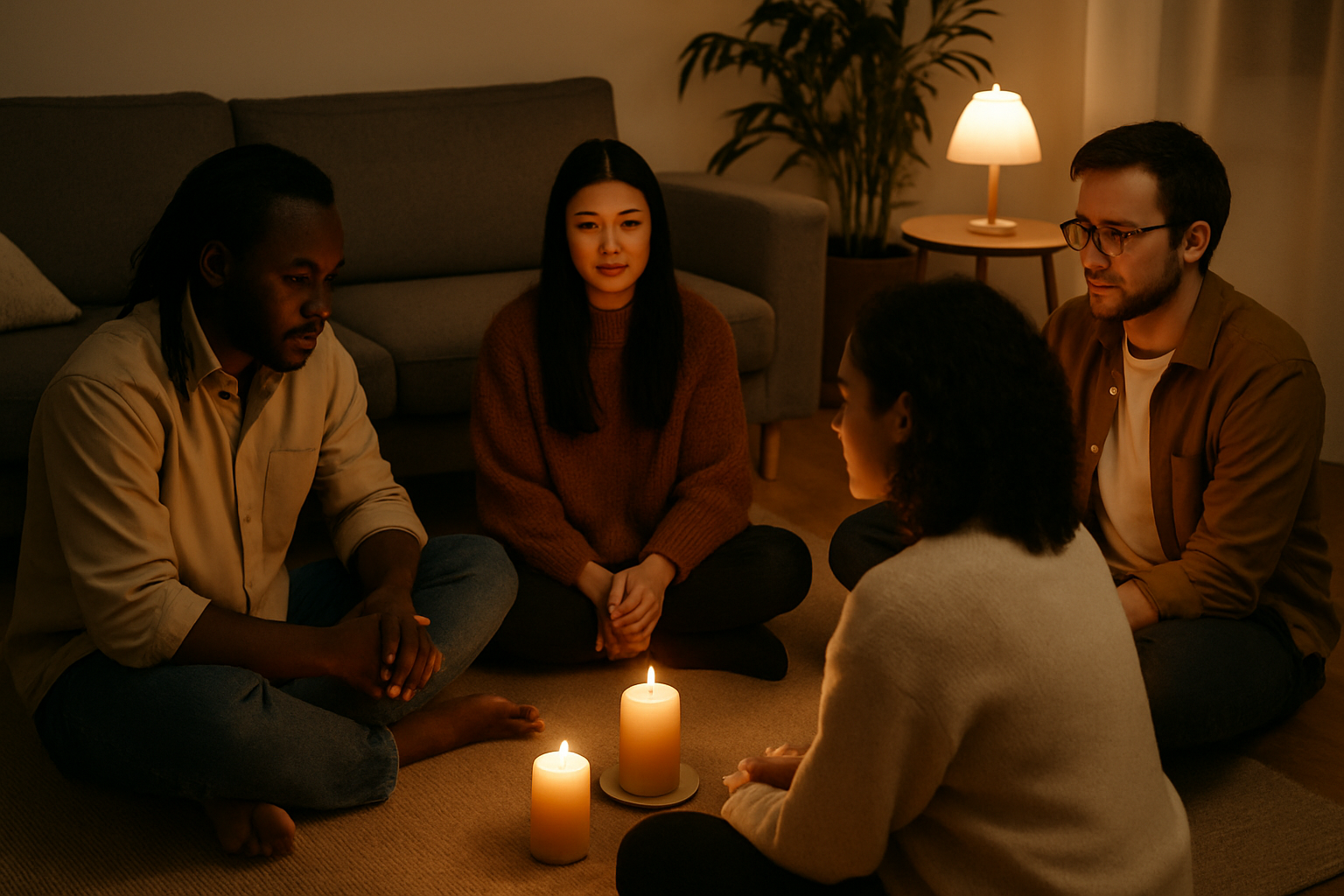
Grief doesn’t always end when the rituals do. After the music fades and the last guest leaves, a different kind of sorrow sets in—the kind that’s quiet, disorienting, and often invisible to others. This piece begins where most stories of loss usually end: in the silence. What unfolded in my small apartment—where friends of all cultures, faiths, and identities came together to hold space—reminded me that while traditions shape how we grieve, it’s community that helps us keep going. This is a story about what happens after the funeral—and why grief coaching rooted in trauma-informed care can make all the difference.
I recently lost my grandfather. But to call him just that—my grandfather—feels far too small. He was my father, my best friend, my mentor, my protector, my compass. He stepped in when no one else did. Every lesson he taught, every story he told, every time he stood in the gap for me—it all lives within me now. His death didn’t just leave a void. It cracked something deep in my foundation.
In the aftermath of his passing, I didn’t want to sit with my sorrow in silence. I leaned into the traditions I was raised with—African village customs that believe grief belongs to all of us. It isn’t something you carry alone.
So I opened my door. Friends came, one by one, then in waves. We gathered. We cried. We prayed. We cooked. We danced. We stayed up all night. There was no script. Just the rhythm of tradition. The kind that says: We grieve together. In that sacred chaos of shared mourning, I felt held. Seen. Cared for. And strangely, even in sorrow—I felt joy. It felt like home.
In many African cultures, grief is not expected to be hidden, silent, or neatly managed. It is loud. It is shared. It is embodied. Death is not just about loss—it’s a collective moment to honor a life and remind the living that they still belong. When someone dies, the village shows up. Singers lead laments. Dancers move their bodies to say what words cannot. Elders pray and pour libations, guiding the soul home while calling on the ancestors. Children play underfoot. Food is shared. No one is turned away. No one grieves alone.
These rituals aren’t just spiritual—they’re structural. They hold you when you feel unmoored. They remind you that even in death, there is connection. Even in pain, there is tradition. The mourning becomes a rhythm. And within that rhythm, you start to breathe again.
But then the night ends. 
Everyone goes home.
The dishes are washed. The candles burn out. The laughter and weeping fade. And what’s left is the silence.
No one tells you how loud the silence feels once the room empties. I wasn’t ready for it. When I woke up the next morning, alone in my apartment, I felt the weight of everything that was no longer there. The silence didn’t feel peaceful—it felt piercing. I realized then: grief doesn’t end with the rituals. That’s only the beginning.
That’s also when I thought deeply about how different cultures handle this stage of grief—the part no one sees. In many American traditions, especially in modern, Westernized settings, grief often becomes a private matter. You’re expected to take a few days off, maybe attend a funeral, and then “get back to normal.” There’s often an underlying discomfort with grief. An expectation to keep it tidy. Personal. Contained.
Unlike the communal rituals I grew up with, American culture tends to separate people in their pain. There may be sympathy cards and casseroles, but rarely the kind of long, sustained communal support that says: We are here. Still. With you. Even after the funeral ends.
And yet—this weekend, something beautiful happened.
I opened my tiny apartment to a group of friends, some of whom had never met each other. Different races. Different cultures. Different religions. Different gender identities. People I loved, and who loved me, gathered in one small space simply to hold grief with me. There was no uniform tradition—just shared humanity.
We brought our stories. Our silences. Our prayers and laughter. Some offered scripture. Others sang softly. One friend brought a dish her grandmother used to make when someone died. Another shared a poem about losing her father. There were hugs, tissues, music, and gentle moments of eye contact that said: I see you. I feel this with you.
It reminded me that healing doesn’t just live in tradition—it lives in intention. It lives in the present. And when people show up across differences to grieve together, something sacred happens. A community doesn’t have to look like a village or a ceremony. It can be a living room with mismatched chairs and the shared ache of loss.
That gathering reminded me that love transcends culture. That while our traditions may differ, the need to be seen in our grief is universal. And that in this modern world—where loneliness is epidemic and grief often goes underground—spaces of shared mourning are radical acts of love.
And yet, even after that powerful weekend, when the door closed and everyone left, the silence returned.
But this time, it felt different.
Not because the grief was gone—but because I knew I had been seen in it. Held in it. I wasn’t alone.
This is why I started Beneath the Silence. It was born out of moments like these—the ones after the rituals, when the tears have dried but the ache remains. It’s for the quiet days. The empty mornings. The long nights. It’s for those who know the world has moved on, but they haven’t.
I believe we need spaces that extend beyond the funeral. That honors the long, nonlinear, often invisible path of grief. Whether you’re grounded in ancestral traditions, modern therapy, spiritual practices, or just learning to name your feelings—grief deserves room to breathe.
So if you’ve ever felt that silence—after the people leave, after the food is packed up, after the prayers end—know this:
You are not the only one.
And you don’t have to carry the weight alone.
Your grief matters. Your sorrow deserves space. And your healing, though it may begin in solitude, can always be nurtured in community.
If you’re longing for a space where your grief can be held gently, at your own pace, I offer trauma-informed grief coaching through Beneath the Silence. When you’re ready, I’m here
With Love,

Epiphany